

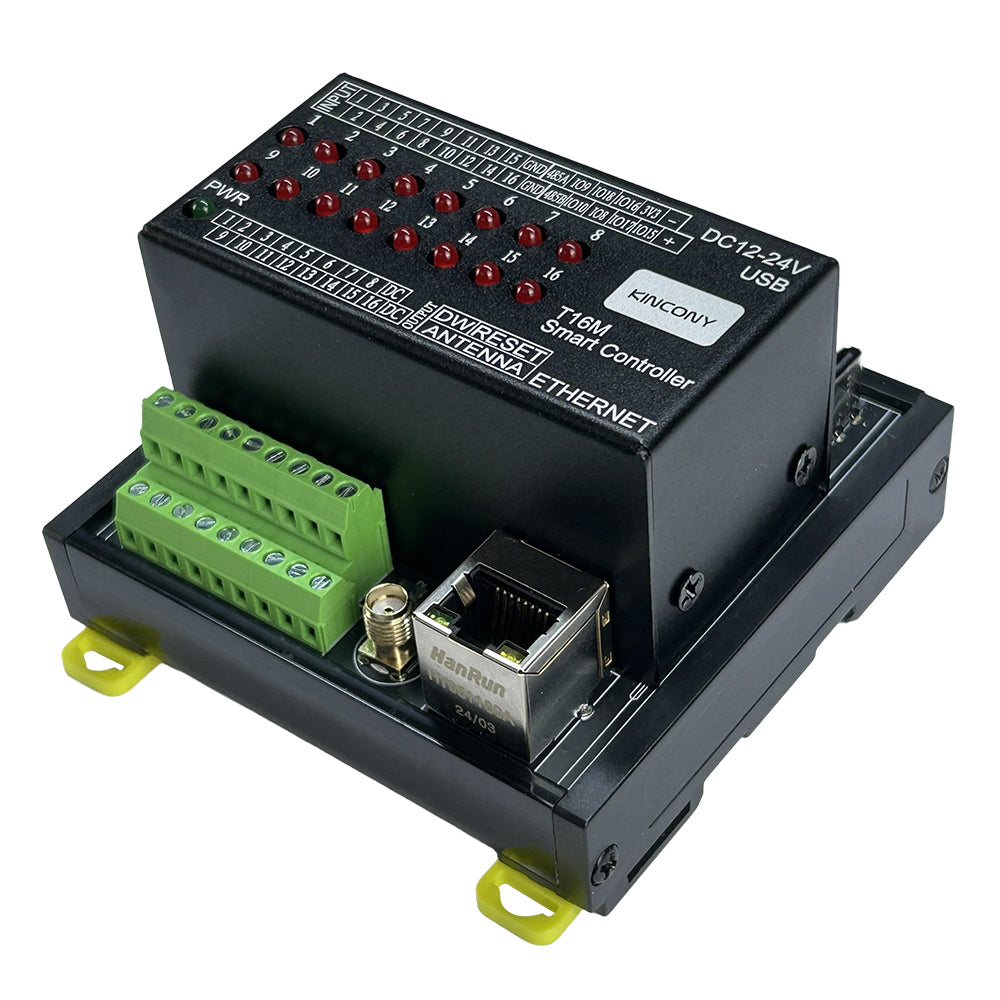


KinCony T16M 16-Channel Compact Programmable Smart MOSFET Controller
Frequently Bought Together
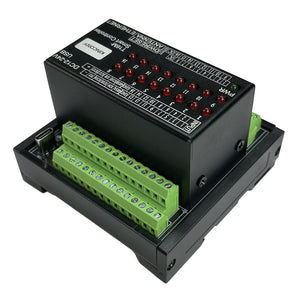
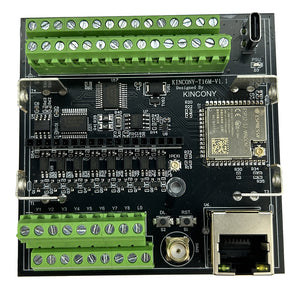
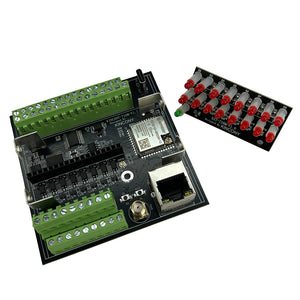
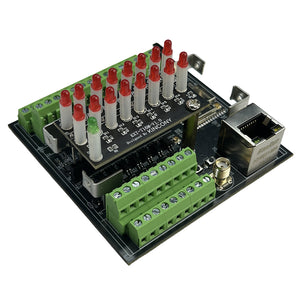
Unlock high-density control in a palm-sized package. The KinCony T16M redefines compact automation with 16 MOSFET channels packed into a remarkably small, DIN-rail mountable enclosure. Leveraging the power of the ESP32-S3, this tiny commander delivers solid-state switching speed, opto-isolated reliability, and full IoT connectivity, making it the perfect solution for space-constrained cabinets, distributed control nodes, or projects requiring a clean, minimalist setup without sacrificing channel count.
Why You'll Love This Controller
✔ Master Space and Density
Achieve professional-grade control in a fraction of the space. The T16M’s tiny size allows you to add sophisticated 16-channel control where traditional controllers simply won't fit.
✔ Harness the Speed of Solid-State
Enjoy the benefits of MOSFET technology: no moving parts, silent operation, instant switching, and exceptional longevity-ideal for PWM control and frequent cycling of loads.
✔ Your Seamless IoT Gateway
Integrate effortlessly into your smart ecosystem. It's fully compatible with Home Assistant (via MQTT Auto-Discovery), Apple HomeKit, and the multi-protocol KCS v3 firmware for local or cloud-based management.
✔ Built for Reliable, Distributed Control
With its robust isolated inputs and industrial communications (RS-485), the T16M is perfect as a reliable node in larger automated systems or standalone in demanding environments.
✔ Open Platform for Agile Development
Take full control with Arduino IDE, MicroPython, or ESP-IDF. Rapidly prototype and deploy custom logic tailored to your specific application needs.
Among other outstanding features are the following:
-
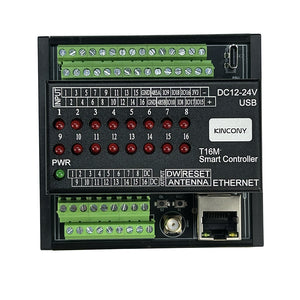
Ultra-Compact, High-Density Design: 16 MOSFET output channels integrated into a footprint of just 87x83x56mm, maximizing panel space efficiency.
-
Solid-State Speed & Reliability: 4A-rated MOSFETs provide silent, fast, and long-life switching for DC loads like LEDs, solenoids, and small motors.
-
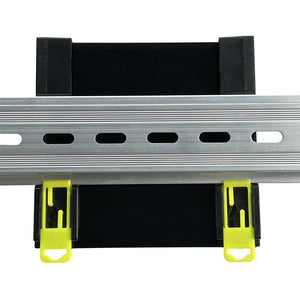
Professional Installation Ready: Standard DIN-rail mounting allows for quick, organized integration into any industrial or electrical enclosure.
-
Robust Connectivity: Equipped with both Wi-Fi and 100Mbps Ethernet for flexible network integration, plus RS-485 for industrial serial communication.
-
Extensive Input Capacity: Features 16 opto-isolated dry contact inputs, matching its output count for balanced monitoring and control applications.
Technical Specifications:
| Category | Specification |
|---|---|
| Core Processor | ESP32-S3-WROOM-1U (N16R8, dual‑core 32‑bit Xtensa LX7) |
| Digital Outputs | 16× MOSFET ▪ Max load: 4 A per channel |
| Analog Inputs | / |
| Digital Inputs | 16× dry contact, opto‑isolated ▪ Cable length: up to 500 m (dependent on installation) |
| Digital I/O (GPIO) | ▪ 7× 1‑Wire interface (with pull‑up) |
| Wireless Connectivity | ▪ Wi‑Fi 2.4 GHz (802.11 b/g/n) ▪ Bluetooth 5.0 (BLE) |
| IoT Platform | / |
| Wired Connectivity | ▪ Ethernet: 100M RJ45 (IPv4/IPv6) ▪ RS485 ▪ USB‑C (power/programming) |
| Onboard Peripherals | / |
| Power Supply | 12-24 VDC |
| Dimensions | 87 × 83 × 56 mm |
| Mounting | 35 mm DIN rail (EN 60715) |
I. Firmware Options and Features
| Solution | Ideal For | Key Advantages |
|---|---|---|
| 1. KCS v3 Firmware (Recommended) | Beginners / Zero-Code Users | ✔ Auto-detects Home Assistant via MQTT (no config files) ✔ Works with Tuya App + Alexa/Google Voice Control ✔ Local IFTTT automation (no internet needed) ✔ 2-year free KinCony Cloud (official store only) ✔ Apple HomeKit support (one-tap setup) |
| 2. ESPHome Firmware | Home Assistant Enthusiasts | ✔ Full open-source customization ✔ Web UI + HA deep integration ✔ Full YAML examples |
| 3. Tasmota Firmware | Open-Source Community | ✔ Massive plugin ecosystem ✔ MQTT/Web control + rule engine |
| 4. Arduino/ESP-IDF Custom Code | Developers | ✔ Full Arduino demos ✔ Supports MicroPython/ESP-IDF |
| 5. Hybrid Setup (Best Practice) | Advanced Users | Tuya App (remote via internet) + Home Assistant (local via LAN) – Security + convenience |
II. Technical Resources by Product
Direct links to pin definitions, ESPHome configurations, Arduino demo source codes, and KCS firmware. All open-source and maintained on GitHub.
| Model | KCS Firmware | Pin Definitions | ESPHome (YAML) | Arduino Demos |
|---|---|---|---|---|
|
F4
4‑ch relay · 4 inputs
ADS1115 |
📦 kcs_{KCS_VERSION}.bin | 📄 F4_pin_definition.md |
🔹 with Tuya Tuya module
🔸 without Tuya Ethernet/WiFi only
|
📁 F4/ (11 examples) |
|
F8
8‑ch relay · 8 inputs
PCF8575 |
📦 kcs_{KCS_VERSION}.bin | 📄 F8_pin_definition.md |
🔹 with Tuya Tuya module
🔸 without Tuya Ethernet/WiFi only
|
📁 F8/ (11 examples) |
|
F16
16‑ch relay · 16 inputs
PCF8575 |
📦 kcs_{KCS_VERSION}.bin | 📄 F16_pin_definition.md |
🔹 with Tuya Tuya module
🔸 without Tuya Ethernet/WiFi only
|
📁 F16/ (11 examples) |
|
F24
24‑ch relay · 24 inputs
3×PCF8575 |
📦 kcs_{KCS_VERSION}.bin | 📄 F24_pin_definition.md |
🔹 with Tuya Tuya module
🔸 without Tuya Ethernet/WiFi only
|
📁 F24/ (12 examples) |
|
F32
32‑ch relay · 32 inputs
3×PCF8575 |
📦 kcs_{KCS_VERSION}.bin | 📄 F32_pin_definition.md |
🔹 with Tuya Tuya module
🔸 without Tuya Ethernet/WiFi only
|
📁 F32/ (11 examples) |
| Model | KCS Firmware | Pin Definitions | ESPHome (YAML) | Arduino Demos |
|---|---|---|---|---|
|
T16M
16‑ch relay + 16 inputs
single I2C bus |
📦 kcs_{KCS_VERSION}.bin | 📄 T16M_pin_definition.md | 📁 T16M/ (6 examples) | |
|
T32M
32‑ch relay + 32 inputs
dual I2C bus |
📦 kcs_{KCS_VERSION}.bin | 📄 T32M_pin_definition.md | 📁 T32M/ (7 examples) | |
|
T64M
64‑ch relay + 64 inputs
dual I2C buses |
📦 kcs_{KCS_VERSION}.bin | 📄 T64M_pin_definition.md | 📁 T64M/ (8 examples) | |
|
T128M
128‑ch relay + 128 inputs
dual I2C buses |
📦 kcs_{KCS_VERSION}.bin | 📄 T128M_pin_definition.md | 📁 T128M/ (8 examples) | |
|
TA
Thermostat Adapter
|
📦 kcs_{KCS_VERSION}.bin | 📄 TA_pin_definition.md | 📁 TA/ (11 examples) |
🔸 v2 high‑precision ESPHome configs (0.001 kWh) require ARM CPU firmware ≥ V20_260305SP.
| Model | KCS Firmware | Pin Definitions | ESPHome (YAML) | Arduino Demos |
|---|---|---|---|---|
|
N10
10‑ch energy meter
|
📦 kcs_{KCS_VERSION}.bin | 📄 N10_pin_definition.md |
🔹 N10_esphome.yaml v1 (1 kWh)
🔸 N10_esphome_v2.yaml v2 (0.001 kWh)
v2 require ARM CPU firmware ≥ V20_260305SP. |
📁 N10/ (5 examples) |
|
N20
20‑ch energy meter
|
📦 kcs_{KCS_VERSION}.bin | 📄 N20_pin_definition.md |
🔹 N20_esphome.yaml v1 (1 kWh)
🔸 N20_esphome_v2.yaml v2 (0.001 kWh)
v2 require ARM CPU firmware ≥ V20_260305SP. |
📁 N20/ (5 examples) |
|
N30
30‑ch energy meter
|
📦 kcs_{KCS_VERSION}.bin | 📄 N30_pin_definition.md |
🔹 N30_esphome.yaml v1 (1 kWh)
🔸 N30_esphome_v2.yaml v2 (0.001 kWh)
v2 require ARM CPU firmware ≥ V20_260305SP. |
📁 N30/ (5 examples) |
|
N60
60‑ch energy meter
|
📦 kcs_{KCS_VERSION}.bin | 📄 N60_pin_definition.md |
🔹 N60_esphome.yaml v1 (1 kWh)
🔸 N60_esphome_v2.yaml v2 (0.001 kWh)
v2 require ARM CPU firmware ≥ V20_260305SP. |
📁 N60/ (5 examples) |
| Model | KCS Firmware | Pin Definitions | ESPHome (YAML) | Arduino Demos |
|---|---|---|---|---|
|
DM4
4‑ch digital input module
|
📦 kcs_{KCS_VERSION}.bin | 📄 DM4_pin_definition.md |
🔸 without Tuya Ethernet/WiFi only
|
📁 DM4/ (11 examples) |
|
DM8
8‑ch digital input module
|
📦 kcs_{KCS_VERSION}.bin | 📄 DM8_pin_definition.md |
🔸 without Tuya Ethernet/WiFi only
|
📁 DM8/ (11 examples) |
|
DM16
16‑ch digital input module
|
📦 kcs_{KCS_VERSION}.bin | 📄 DM16_pin_definition.md |
🔹 with Tuya Tuya module
🔸 without Tuya Ethernet/WiFi only
|
📁 DM16/ (11 examples) |
|
DM32
32‑ch digital input module
|
📦 kcs_{KCS_VERSION}.bin | 📄 DM32_pin_definition.md |
🔸 without Tuya Ethernet/WiFi only
|
📁 DM32/ (11 examples) |
| Model | KCS Firmware | Pin Definitions | ESPHome (YAML) | Arduino Demos |
|---|---|---|---|---|
|
G1
Gateway controller
|
📦 kcs_{KCS_VERSION}.bin | 📄 G1_pin_definition.md | Not supported | 📁 G1/ (11 examples) |
|
AIO Hybrid
All‑in‑one hybrid controller
RF433 · Zigbee · IR · DAC |
📦 kcs_{KCS_VERSION}.bin | 📄 AIO_Hybrid_pin_definition.md |
🔹 with Tuya Tuya module
🔸 without Tuya Ethernet/WiFi only
|
📁 AIO Hybrid/ (13 examples) |