


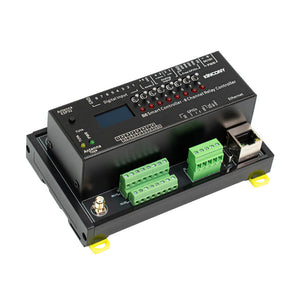

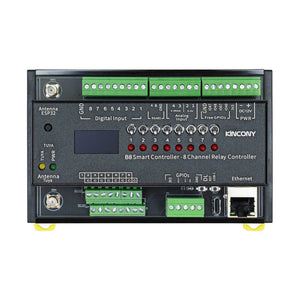


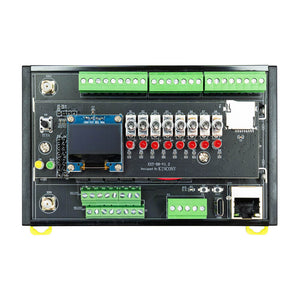
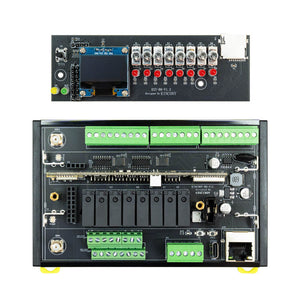
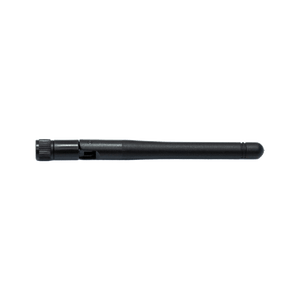
KinCony B8 8-Channel Smart Relay Controller
Frequently Bought Together

Features
- Eight Industrial-Grade Relay Channels — Equipped with 8× heavy-duty relays featuring a unique COM / NC (Normally-Closed) configuration, rated at 250VAC / 30VDC, 7A per channel. Ideal for high-density AC switching and specific fail-safe logic.
- 8-Channel Opto-Isolated Digital Inputs — Includes 8× dry contact inputs with optocoupler isolation, supporting cable runs up to 500 meters for reliable status feedback from push buttons, limit switches, and industrial sensors.
- Precision Sensing Suite — Features 4× 16-bit ADC channels for high-accuracy analog monitoring: 2× 0–5 VDC and 2× 4–20 mA loop-powered inputs, ideal for pressure, level, and temperature transmitters.
- Redundant Network & Industrial Bus — Dual connectivity with Wi-Fi and 100Mbps Ethernet ensures reliable local/remote access. Includes an isolated RS485 port for long-distance Modbus communication.
- Standalone Time Intelligence & Diagnostics — Onboard DS3231 RTC (with battery backup) keeps perfect time even without internet, while the OLED display provides at-a-glance IP address and status, and the microSD slot enables local data logging.
- Fail-Safe Manual Override — Physical toggle switches for each relay channel allow you to force loads ON or OFF directly, guaranteeing continuous operation and simplifying troubleshooting during network drops.
- Seamless Ecosystem Integration — Supports Home Assistant auto-discovery (zero-config), KinCony Cloud, Loxone, Apple HomeKit, and Tuya for unified local and cloud automation.
- Flexible Firmware & Development — Full support for KCS firmware (HTTP, MQTT, TCP, RS485 Modbus, Tuya), ESPHome, Tasmota, Arduino IDE, MicroPython, and ESP-IDF.
Why Choose
B-Series Positioning: The B8 belongs to KinCony's B-Series economy line — the 2nd-generation successor to the original A-Series. It is the highest-density AC control model in the series, packing 8 high-power relay channels into a single DIN-rail device at a highly competitive price.
- High-Density AC Control at a Value Price — Unlike the B8M (which is strictly DC-only) and the F8 (which targets premium industrial budgets with pluggable OMRON® relays), the B8 delivers 8 channels of AC mains control at a fraction of the cost, making it perfect for large lighting arrays, pumps, and multi-zone automation panels.
- Unique COM / NC Relay Configuration — Most standard relay boards use Normally-Open (NO) contacts. The B8 features a Normally-Closed (NC) configuration, offering a distinct hardware advantage for specific safety logic, fail-safe circuits, or security systems where power must remain connected by default.
- Optimized for Dedicated 12V Systems — While the B8M and F8 accept 12–24V wide voltage, the B8 is engineered natively for 12V DC power systems. If your entire cabinet runs on 12V, the B8 provides a more cost-effective fit without paying for unused wide-voltage components.
- Right Choice vs B8M and F8 — Choose B8 for affordable, high-density AC mains control with NC contacts. Choose B8M only for silent switching, or for driving external relays or contactors. Choose F8 for industrial-grade pluggable OMRON® relays, 16A capacity, and built-in 433MHz RF. The B8 sits at the best-value sweet spot for multi-channel AC panels.
- No Compromise on Software Freedom — Be platform-agnostic. Use Home Assistant locally, integrate via Apple HomeKit, manage remotely with Tuya Smart, or leverage our powerful KCS firmware with multi-protocol support.
Technical Specifications:
| Category | Specification |
|---|---|
| Core Processor | ESP32-S3-WROOM-1U (N16R8, dual‑core 32‑bit Xtensa LX7) |
| Analog Inputs |
4× 16‑bit ADC ▪ 2× 0–5 VDC ▪ 2× 4–20 mA (loop‑powered) |
| Digital Inputs |
8× dry contact, opto‑isolated ▪ Cable length: up to 500 m (dependent on installation) |
| Digital Outputs |
8× relays ▪ Contact: COM, NC (1 × SPST-NC / Form B per channel) ▪ Max load: 250 VAC / 30 VDC, 7 A per channel |
| Free GPIOs |
▪ 3× without PCB pull-up resistors (GPIO13, GPIO14, GPIO21) ▪ 4× with PCB pull-up resistors (GPIO40, GPIO47, GPIO48, GPIO7) |
| Wireless Connectivity | ▪ Wi‑Fi 2.4 GHz (802.11 b/g/n) ▪ Bluetooth 5.0 (BLE) |
| IoT Platform | Tuya‑compatible (via Wi‑Fi/Bluetooth) |
| Wired Connectivity | ▪ Ethernet: 100M RJ45 (IPv4/IPv6) ▪ RS485 ▪ USB‑C (programming) |
| Onboard Peripherals | ▪ RTC: DS3231 (battery socket) ▪ Display: SSD1306 128×64 OLED (I²C) ▪ Storage: microSD card socket ▪ Buttons: 3× (ESP32 Reset / ESP32 Download / Tuya Config) ▪ Toggle Switches: 8× (Manual relay ON/OFF control) |
| Power Supply | 12 VDC |
| Dimensions | 135 × 83 × 56 mm |
| Mounting | 35 mm DIN rail |
Onboard Components


-
1.
ESP32-S3-WROOM-1U N16R8 Chip
Adopts ESP32-S3 series chip with Xtensa 32-bit LX7 dual-core processor, built in 16MB Flash and 8MB PSRAM -
2.
Tuya Chip
Tuya wireless communication module for cloud connectivity and smart control -
3.
Relays
8-channel high-power mechanical relays for direct AC/DC load switching -
4.
RTC Battery Holder
Battery holder, maintains RTC timekeeping when main power is off -
5.
Digital Input Terminals
Screw terminals for dry contact digital input, opto-isolated -
6.
RS485 Terminals
Screw terminals for RS485 communication (A / B) -
7.
Analog Input Terminals
Screw terminals for analog input (0–5 V / 4–20 mA) -
8.
Free GPIO Terminals
Screw terminals for free GPIO access for custom IO projects -
9.
Power Supply Screw Terminal
Supports DC 12V power input -
10.
Relay Terminals
Screw terminals for relay output connection -
11.
1-Wire GPIO Terminals
Screw terminals for 1-Wire devices such as temperature sensors
-
12.
Tuya Antenna Connector
SMA female connector, for Tuya wireless communication -
13.
ESP32 Download Button
Download button for ESP32 firmware flashing -
14.
ESP32 Reset Button
Reset button for ESP32 module -
15.
USB-C Port
For firmware flashing only (cannot be used for power supply or data communication) -
16.
ESP32 Antenna Connector
SMA female connector, for Wi-Fi and Bluetooth wireless communication -
17.
Ethernet Port
100M RJ45 Ethernet port for stable wired network connection -
18.
Ethernet Controller Chip
Extends 10/100 Mbps Ethernet via SPI interface -
19.
Low-Dropout Linear Regulator (LDO)
Provides stable 3.3V output for onboard circuits -
20.
PCF8578 I²C 16-bit IO Expander
I²C bus IO expander chip, expands available digital input/output channels -
21.
RS485 Transceiver
RS485 transceiver chip for reliable long-distance serial communication


-
22.
0.96" OLED Display
Displays the IP addresses for Wi-Fi, Ethernet, and Tuya connections -
23.
microSD Card Slot
Supports external TF card for local data logging and file storage -
24.
Manual Override Toggle Switches
Physical toggle switches for each relay channel, allowing manual ON/OFF control -
25.
Tuya Config Button
Config button for Tuya network pairing -
26.
Relay Status LEDs
Indicates relay ON/OFF working status -
27.
Power Status LED
PWR indicator, shows power supply status
-
28.
Tuya Status LED
Indicates Tuya cloud connection status -
29.
Optocoupler Isolation
Prevents interference from external signals, ensuring stable operation -
30.
16-bit ADC Chip
High-precision analog-to-digital converter for analog inputs -
31.
TVS Protection
Transient Voltage Suppressor, suppresses surge voltages and transient spikes -
32.
Reverse Polarity Protection
Protects the circuit from reverse power connection
Onboard Isolation & Protection

Voltage Regulator
Provides a stable 3.3V output, protecting the core chip from voltage fluctuations.
Reverse Polarity Protection
Prevents circuit damage caused by accidental reverse power connection.
Thicken Track
Reinforced copper traces for high-current paths, ensuring stable power delivery under heavy loads.
TVS Protection
Transient Voltage Suppressors absorb surge voltages and spikes, safeguarding sensitive components.
Optocoupler Isolation
Isolates external signals from the MCU, preventing interference and voltage spikes.
System Block Diagram

Outline Dimensions

Front View — Overall 135 × 83 mm / Aluminum cover 122 × 46 mm

Side View — Overall height 56 mm / Aluminum cover height 40 mm
Overall Length
135 mm
Overall Width
83 mm
Overall Height
56 mm
Mounting
35 mm DIN
Enclosure Design

Top View — Aluminum Top Cover

Aluminum Cover Detail

Back View — Plastic Base with 35 mm DIN Rail Mount

DIN Rail Base Detail — 35 mm Standard DIN Rail
Aluminum Top Cover Advantages
1. Premium Feel: Compared with ordinary ABS plastic cases, the aluminum top cover offers a more solid, high-end texture and better heat dissipation.
2. EMI Shielding: As a non-magnetic conductor, the aluminum top cover acts as a Faraday cage, protecting internal circuits from external electromagnetic radiation and preventing internal emissions.
Supports Arduino, Micropython, ESP-IDF development

Arduino IDE
Arduino IDE is an open-source electronic prototyping platform. It is convenient, flexible, and easy to start. With a simple learning curve, you can rapidly develop your projects.

MicroPython
MicroPython is a full implementation of Python 3 that runs directly on embedded hardware. It enables agile IoT development like Raspberry Pi Pico.

ESP-IDF
ESP-IDF is Espressif's official development framework. It provides low-level hardware access, maximum performance, and professional control for production-grade firmware.
For full firmware packages, demo codes and programming tutorials, please switch to the "Software Solution" tab above.
Packing List


Please Note: The RTC coin cell battery is not included in the standard package due to shipping regulations.
Batch Customization Service
Support software and hardware customization including interface logo label case etc.
Label Customization
Logo, sticker, nameplate
Hardware Customization
PCB, interface, casing
Software Customization
Firmware, function, UI
Contact Customer Service
Send your customization requirements
One-to-One Technical Service
Professional evaluation and solution
Sign Contract & Start Project
Custom development and sample making
Sample Approval & Mass Production
Batch delivery after sample passes
B8 vs B8M vs F8
Shared Features: ESP32-S3 N16R8 · 100M Ethernet + Wi-Fi + Bluetooth · DS3231 RTC · 4× 16-bit ADC (0–5V & 4–20mA) · OLED display · microSD · RS485 · DIN-rail mounting · ESPHome / Home Assistant / Tuya support.
Key Differences
| Item |
 B8 (8CH Relay) |
 B8M (8CH MOSFET) |
 F8 (8CH Removable Relay) |
|---|---|---|---|
| Output Type | Mechanical relay, COM / NC | MOSFET DC switch (DC loads only) | Pluggable OMRON® SPDT relay, COM / NO |
| Output Quality | Standard relay, 250VAC / 30VDC, 7A per channel | High-current MOSFET, 10A per channel | OMRON® high-grade relay, 250VAC / 30VDC, 16A per channel, socketed |
| Output Channels | 8× relay | 8× MOSFET | 8× removable relay |
| Load Capability | AC up to 250V, 7A per channel. Can switch AC mains. COM/NC (normally closed) configuration. | DC only (recommended 12–24V), 10A per channel. All channels share the same voltage. | AC up to 250V / DC up to 30V, 16A per channel. Can switch AC mains. COM/NO configuration. |
| Switching | Mechanical contact; audible click, limited lifespan | No contact, silent, high-speed; External PWM via free GPIO | Mechanical contact; pluggable for tool-free replacement |
| Digital Inputs | 8× opto-isolated DI (up to 500m) | 8× opto-isolated DI (up to 500m) | 8× opto-isolated DI (up to 500m) |
| GPIO | 3× 1-Wire + 4× free GPIO | 3× 1-Wire + 4× free GPIO | 4× 1-Wire + 1× free GPIO |
| RF Receiver | — | — | 433 MHz RF receiver built-in |
| Power Supply | 12 VDC (fixed) | 12–24 VDC wide voltage | 12/24 VDC (12V default) |
| Dimensions | 135 × 83 × 56 mm | 122 × 83 × 59 mm | 195 × 129 × 64 mm (larger footprint) |
Which One Should You Choose?
Choose B8 if you need:
- 8 channels of AC mains relay control at a competitive price
- COM / NC (normally closed) relay configuration
- Standard 7A relay capacity for typical AC loads
- A fixed 12V DC power system
Choose B8M if you need:
- All loads are DC 12V / 24V (LED strips, solenoid valves, DC motors)
- Silent, high-speed switching with no mechanical wear
- External PWM dimming or speed control via free GPIO
- Wide 12–24V DC input voltage flexibility
Choose F8 if you need:
- Pluggable OMRON® relays for tool-free replacement
- Higher relay rating (16A per channel)
- 433 MHz RF receiver for wireless sensors
- 12/24V DC wide voltage and a larger installation space
I. Firmware Options & Features
| Solution | Ideal For | Key Advantages |
|---|---|---|
| 1. KCS Firmware (Recommended) | Beginners / Zero-Code Users |
✔ Auto-detects Home Assistant via MQTT (zero config) ✔ Works with Tuya App + Alexa/Google Voice Control ✔ Local IFTTT automation (no internet needed) ✔ 2-year free KinCony Cloud (official store only) ✔ Apple HomeKit support for Siri ✔ Supports Loxone Miniserver integration ✔ Multi-protocol: HTTP, MQTT, TCP, RS485 Modbus, Tuya |
| 2. ESPHome Firmware | Home Assistant Enthusiasts |
✔ Full open-source customization ✔ Official ESPHome device support for B8 ✔ Web UI + deep HA integration ✔ Full YAML examples available |
| 3. Tasmota Firmware | Open-Source Community |
✔ Massive plugin ecosystem ✔ MQTT / Web control + rule engine |
| 4. Arduino / ESP-IDF Custom Code | Developers |
✔ Full Arduino demos provided ✔ Supports MicroPython / ESP-IDF |
| 5. Hybrid Setup (Best Practice) | Advanced Users | Tuya App (remote via internet) + Home Assistant (local via LAN) — Security + convenience |
II. Technical Resources
Direct links to pin definitions, ESPHome configurations, Arduino demo source codes, and KCS firmware. All open-source and maintained on GitHub.
| Resource | Link |
|---|---|
| KCS Firmware | kcs_firmware/B8/ |
| Pin Definitions | pin_definitions/B8/B8_pin_definition.md |
| Arduino Demos | B8/ (11 examples) |
| ESPHome Configuration | Official ESPHome B8 device page |
III. Getting Started Guide
Step 1: Flash Firmware
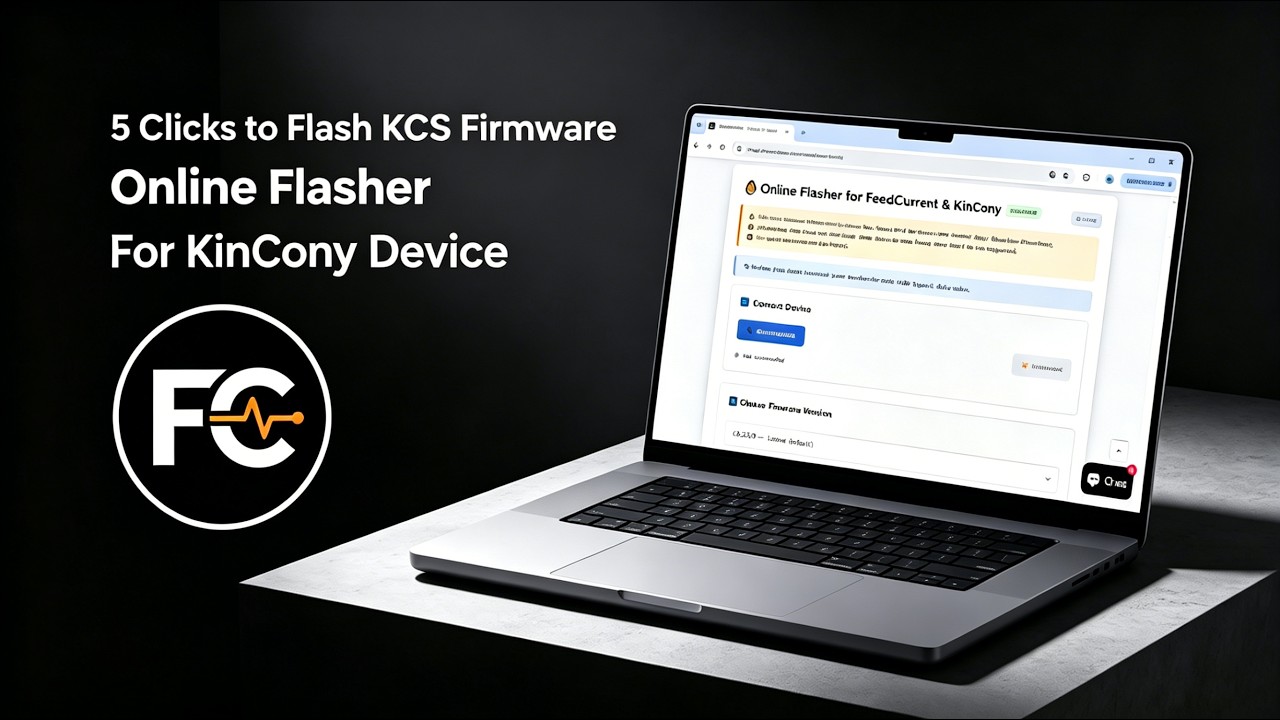
We recommend using the Online Flasher — no driver installation required, works entirely in your browser. Alternatively, follow the Quick Start Guide for manual flashing with the ESP32 desktop tool.
Step 2: Connect & Configure
Power on the board, connect via Ethernet or Wi-Fi, and access the web configuration interface. For detailed configuration, see the KCS Firmware User Guide.
Step 3: Integrate
Enable MQTT auto-discovery in Home Assistant, or pair with Tuya App for voice control.
IV. Video Tutorial: How to Flash KCS Online
No Drivers Needed, No Complex Setup—Flash Directly within Your Browser in 1 Minute!
Looking for software solutions for other products?
View All Product Software Solutions →